How human.tech ran two successful wallet-native campaigns inside MetaMask

theMiracle
Behavioral Intelligence

The problem they faced is one that many web3 projects recognize. Broadcast channels like X and Discord attract volume, but not all of that volume represents users likely to engage with an identity product. Bots, multi-accounts, and low-intent wallets make it difficult to identify users likely to complete a meaningful flow, let alone return to the product afterward.
Focus: Identity-first user acquisition and reactivation.
Outcome: 6,164 revenue-generating actions and a repeat partnership that confirms the outcomes are repeatable.
The challenge
human.tech is building identity infrastructure for web3. The Human Passport is their core product: a privacy-preserving proof of humanity. Their goal is simple but important: create a way for people to prove they’re real without giving up personal data.
The problem they faced is one that many web3 projects recognize. Broadcast channels like X and Discord attract volume, but not all of that volume represents users likely to engage with an identity product. Bots, multi-accounts, and low-intent wallets make it difficult to identify users likely to complete a meaningful flow, let alone return to the product afterward.
They needed a channel that would reach wallets likely to complete the full onboarding flow, not just claim and leave.
The approach
Both campaigns ran natively inside MetaMask. human.tech offered users the chance to create or update a Human Passport, prove humanity through points, and earn HUMN Points for engaging with their ecosystem. MetaMask OG wallets received an additional incentive, targeting wallets with a longer on-chain activity record.
The participation flow was intentionally multi-step. Users had to take real actions that mattered to human.tech. The offer appeared inside the wallet while users were already managing assets and initiating onchain activity.
What happened across both campaigns
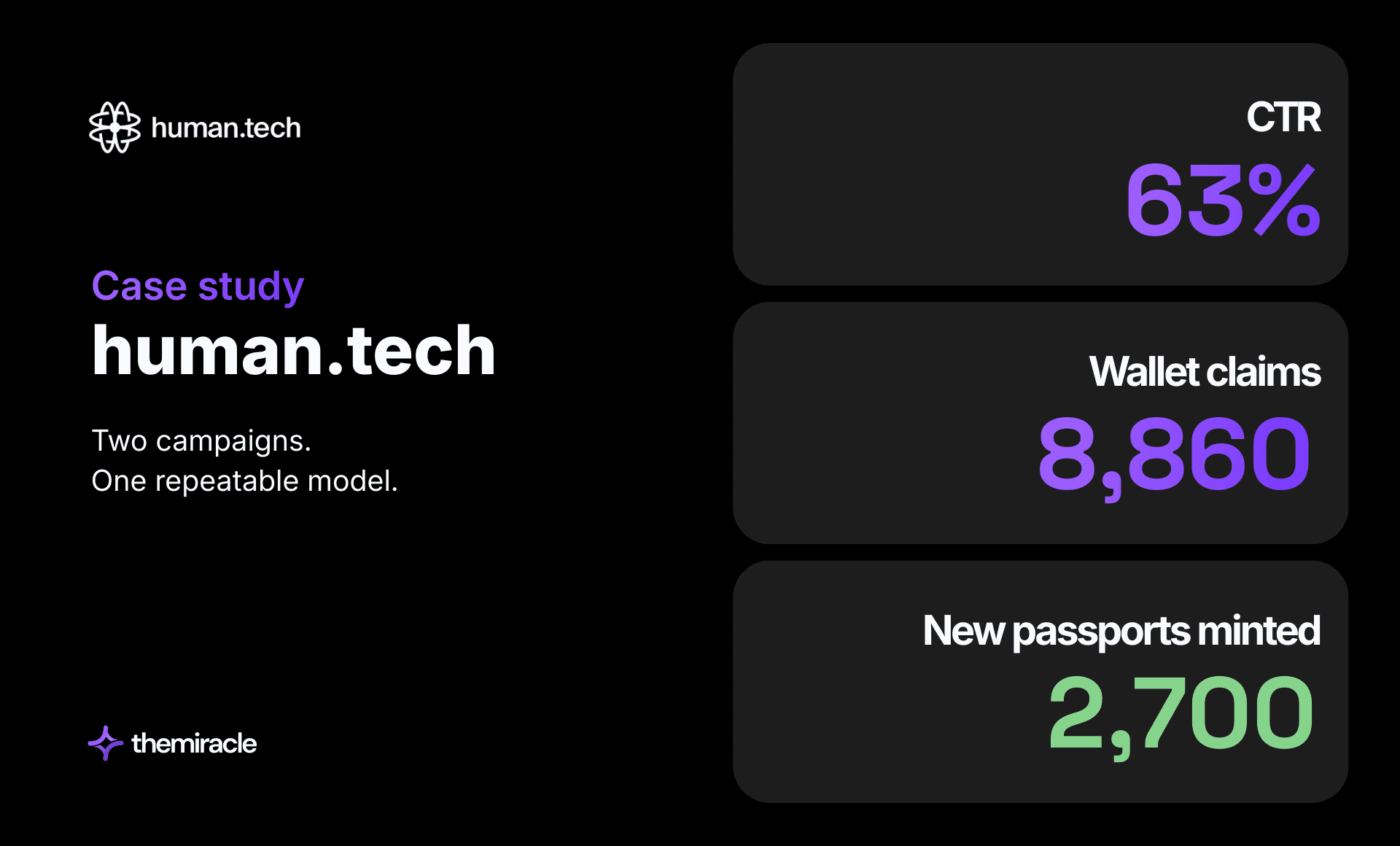
Together, the two campaigns reached 28,620 wallets. 17,999 users clicked. The average CTR across both campaigns was 63% (in a channel where 2% is considered strong performance). In total, 8,860 wallets claimed the offer, and 6,164 users went on to complete revenue-generating actions inside the human.tech ecosystem.
Revenue-generating actions go beyond clicks or claims. They are users who moved deeper into the product and did something that had real economic weight. That is the outcome identity-first, wallet-native distribution is built to produce.
human.tech returned for a second campaign. That campaign delivered 4,289 revenue-generating actions, compared to 1,875 in the first. The second campaign delivered stronger outcomes than the first across every measured step.
Why it worked
The offer appeared inside the wallet while users were already managing assets and initiating on-chain activity. It required users to complete actions with direct relevance to the human.tech product, creating or updating a Human Passport, and engaging with the ecosystem. It only appeared for wallets that met the eligibility criteria.
The multi-step flow had a high completion rate → 8,860 wallets claimed the offer from 17,999 clicks.
Client feedback
The result
Two campaigns. 28,620 wallets reached. 63% average CTR. 6,164 revenue-generating actions.
The campaigns confirmed that wallet-native delivery, conditioned on eligibility, produces users who complete multi-step flows and generate revenue inside the product.
Ready to explore something similar?
If you’re a brand or project exploring wallet-native campaigns that focus on real user actions and measurable outcomes, our DMs are open.
Related Articles

Case Study
Jun 9, 2026
How Claynosaurz acquired 25% new customers inside MetaMask in 7 days

Case Study
Apr 9, 2026
How Doodles generated 8,200 verified users inside Solflare at $1.20 token reward cost per user

Article
Mar 28, 2026
Farming as a signal: what high claim rates without retention tell you about distribution